


Musical director Hilarius Hugo Steinbruch from Brooklyn, N.Y.


This mellow-looking gentleman was Musical Director (“Capellmeister”) Steinbruch, who had his photograph taken in Elizabeth, New Jersey. We didn’t have a first name to go with the photo - but no problem! This man was so well known in the New York and New Jersey’s German singing circles that I was able to identify him even without knowing his given name!

Meet Hilarius Hugo Steinbruch.
Hugo was born on September 24, 1862, in Schwarzburg-Rudolstadt, Thuringia, Germany. On July 15, 1891, he married Malwine Caroline Therese Elisabeth “Elli” Carstanjen in Sudenburg, now part of the city of Magdeburg.
When or how Hugo discovered his passion for music, I do not know. His father, Karl August Steinbruch, was a postmaster. His father-in-law, Ernst Carstanjen, was a German chemist and university professor from Leipzig. The Carstanjens were a family that had achieved prosperity in the 18th century through Rhine shipping between Rotterdam and Duisburg.
In 1902, Hugo and Elli, together with their sons Walter, born February 4, 1893, and Hermann, born August 25, 1894, sailed across the ocean to begin a new life in Brooklyn, New York.
Brooklyn had a very large German-speaking population in the late 1800s and became a major center of German-American choral culture. Numerous singing societies -Männerchöre, Liederkränze, and Sängerbünde - were founded by German immigrants to preserve their language, music, and cultural traditions through choir singing and large singing festivals known as Sängerfeste. The Saengerfest held in Brooklyn in 1900 attracted 174 singing societies and more than 6,000 singers, making it one of the largest German-American musical events ever held.

I suspect Hugo did not simply embark on a new adventure. He seems to have arrived with a clear purpose and perhaps even a job offer that lured him to Brooklyn. I found a newspaper article reporting his successful election as the new Musical Director of the Brooklyn Sängerbund (German for “Brooklyn Singers’ Association”) just four weeks after his arrival in America.

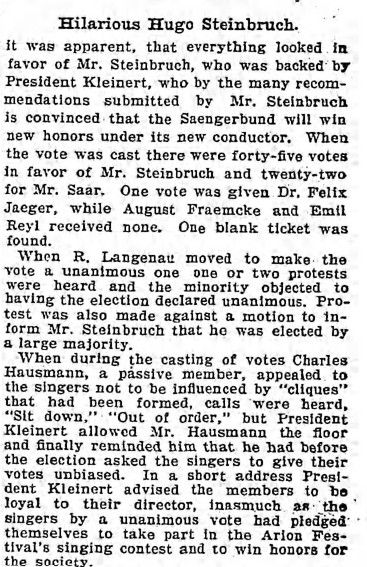


The article even includes a printed image of Hugo - and, as you can see, it is unmistakably the same Capellmeister Steinbruch from our photograph.

The article also gives us fascinating insight into his musical career in Germany.
Before emigrating, Hugo had served as Musical Director of the City of Barmen, Director of the City Orchestra, and Director of the Barmer Quartett-Verein, a mixed choir, and the Barmer Orpheus. The article mentions two of his compositions. One of them was written for Kaiser Wilhelm II’s visit to Barmen in 1900, a major civic occasion for which the city organized elaborate celebrations. According to the article, the city government commissioned Hugo to compose a musical work entitled Kaisergruß (“Salute to the Emperor”). The piece was performed by 800 singers in the presence of the Kaiser himself, who reportedly applauded enthusiastically.
Another newspaper article states that Hugo studied at the Royal Conservatory of Music in Leipzig and graduated in 1886. After touring throughout Germany, Belgium, and Switzerland, he settled in Magdeburg, where he became Concert Master at the Opera House.
Hugo’s election as Musical Director of the Brooklyn Sängerbund in 1902 therefore makes perfect sense. He arrived in America with substantial credentials and extensive experience leading orchestras and choral societies. However, by 1907 some members had grown dissatisfied, as the choir had failed to win awards or prizes at competitions. After five years in office, Hugo resigned.

That did not slow him down in the slightest.
He went on to direct the New York Eichenkranz Orchestra, the Manhattan German Liederkranz, the Bremervoerder Männerchor, and the Bremervoerder Women’s Choir, among others. And what was his connection to Elizabeth, New Jersey, where he had his photograph taken? Naturally, music. In 1912, he was also conductor of the Elizabeth Männerchor.

In the 1910 Census, I find Hugo and his family living at 206 8th Avenue in Brooklyn. I can almost picture him climbing the stairs at the end of a long day, returning home after rehearsing choirs, conducting performances, and teaching singers.

I find references to Hugo in countless newspaper articles, from even before his selection as Musical Director of the Brooklyn Sängerbund in 1902 - apparently internal intrigues played a role in bringing him all the way from Germany - to notices that appeared right up until his death in 1934. He continued leading and conducting choirs for the rest of his life.


The activities of German singing societies declined sharply during and after the First World War. Anti-German sentiment reduced the public use of the German language and weakened many German-American institutions that had once flourished.
By the time of the 1930 Census, Hugo and Elli were living in Mahwah, Bergen County, New Jersey, away from the bustle of Brooklyn. One thing managed to slow him down indeed - he passed away from an illness of 13 months in 1934:

Although his boys found career paths of their own, Hugo's love for choir and classical music was also passed on to his sons. Both of them were active in choirs or played an instrument, at least in their younger years.
Walter Steinbruch became a civil engineer, served during the Second World War, and married Marie née Fournier. The couple had a son, Robert.
Hermann Steinbruch worked in radio and television advertising for Variety and served as general manager of several radio stations. He was a First World War veteran, a Freemason, a violinist, and concert master of the Ridgewood Gilbert and Sullivan Opera Company. With his wife Bertha, he had a son, Richard, and a daughter, Betsy.
I cannot help but wonder about the journey of this photograph. Was it sent to relatives Hugo left behind when he emigrated in 1902? Or perhaps he brought it with him when he returned to Germany for a visit in 1908?
One thing seems certain: Hugo lived for music. In many ways, he appears to have lived through music. He also seems to have been one of those remarkable people who somehow had more than 24 hours available to them each day. :-)Think of the hundreds -perhaps even thousands - of people whose lives he touched through his musical education, leadership, and inspiration.
What a legacy to leave behind.


Kommentare