


Karl Geilfus from Giessen, Germany


A simple piece of thin cardboard, typical of the 1870s. A faded yellow face of a toddler, a location Giessen, and someone’s handwriting in modern German spelling out Karl Geilfus.

Karl Geilfus from Giessen, Germany.
Little did I know that this seemingly simple photograph would lead me into a family with deep roots in Giessen - and that I would uncover quite a lot along the way.
Karl Georg Friedrich Wilhelm Geilfus (sometimes also written as Geilfuß or Geilfuss) was born on July 13, 1871, in Giessen. That means this little babe was born 155 years ago! I don’t often get to research photographs from the early 1870s, so I was particularly excited about this one.
And then the family story started to unfold.
Karl’s father was Karl Christian Wilhelm Theodor Geilfus, a pharmacist and the son of the pastor in Höchst im Odenwald, Georg Ferdinand Geilfus. In 1868, Theodor Geilfuß took over a business in Giessen dealing in timber, floorboards, plaster, coal, iron, cast-iron goods, slate, etc., under the company name Daniel Wirth's Nachfolger (“Successors to Daniel Wirth”).
By 1869, he was listed as a merchant in Giessen, and that same year he married Gertrude Johannette Auguste née Thorwart. Gertrude was the daughter of Grand Ducal Court Advocate Eduard Thorwart. Sadly, she died in 1875, when Karl, his older brother Georg and their younger sister Elisabeth were just small children. Their aunt helped out after their mother's passing. They grew up in the distinctive family home at Westanlage 49 in Giessen:

Father Theodor remained in the timber business for many decades. In 1920, he retired, and the building materials and coal business was taken over by his son, Karl.
The city directories give us a few glimpses into Karl’s career. In the 1910 and 1911 Giessen city directories, he was listed as an accountant, while in 1920 he was described as an authorized signatory and general manager.
Karl had married Elise née Hagenow in 1905. She was ten years younger than him. They seem to have had a son, Karl Geilfus Jr., who was born in October 1915.
Karl Sr. died in May 1966. Three years later, his wife Elise was laid to rest beside him at the New Cemetery of Giessen.

So far, this would already have been an interesting little family story.
But then I came across some juicy family drama.
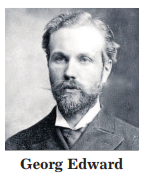
Karl’s older brother Georg - full name Georg Daniel Eduard August Andreas Geilfus, born in December 1869, and who later dropped the surname Geilfus and changed his name into Georg Edward - was apparently expected to take over the family business. After all, taking over the family business was often considered the eldest son’s duty.
But Georg had absolutely no interest in business. His interests were completely different. He was a born academic and writer.
And this caused a clash between father and son. The conflict apparently became so serious that Theodor eventually expelled Georg from the family home with the help of lawyers.
In reaction to this, Georg emigrated to the USA, where he took up a teaching position as a professor of German in the German Department at Northwestern University in Evanston.
He continued to write and publish poetry. After WWI, when attitudes towards Germans in the USA had turned sour, Georg returned to Germany. He was also an important contemporary witness: he kept a diary for 70 years, including during the Nazi period.
And there was yet another fascinating chapter to this family.
Karl’s sister Elisabeth Wagner had a daughter, Auguste “Guti” Wagner (1900–1987). Guti refused to be intimidated by the Nazis and helped her Jewish friends. After being denounced, she was imprisoned in Waldheim Prison in Saxony. In 1986, she was awarded the Hedwig Burgheim Medal of the City of Giessen for “her civic courage.”
And suddenly, that faded little face on a piece of 1870s cardboard had turned into the starting point for a family story spanning generations - from childhood loss and family feuds, to one brother who chose the family business while another chose literature, to a 70-year diary documenting turbulent times, and to a niece who risked her own freedom to help her Jewish friends.
Not bad for a little toddler whose name was simply written on the back of a lost photograph.


Kommentare